
In October last year I went on a train trip through France and into Italy, eventually arriving in Puglia in the heel of Italy. The scenery was classic Italian, bucolic – and sometimes shambolic – countryside with many olive groves. Some of the trees were young, small and well groomed, but many others were ancient, twisted and often enormous.
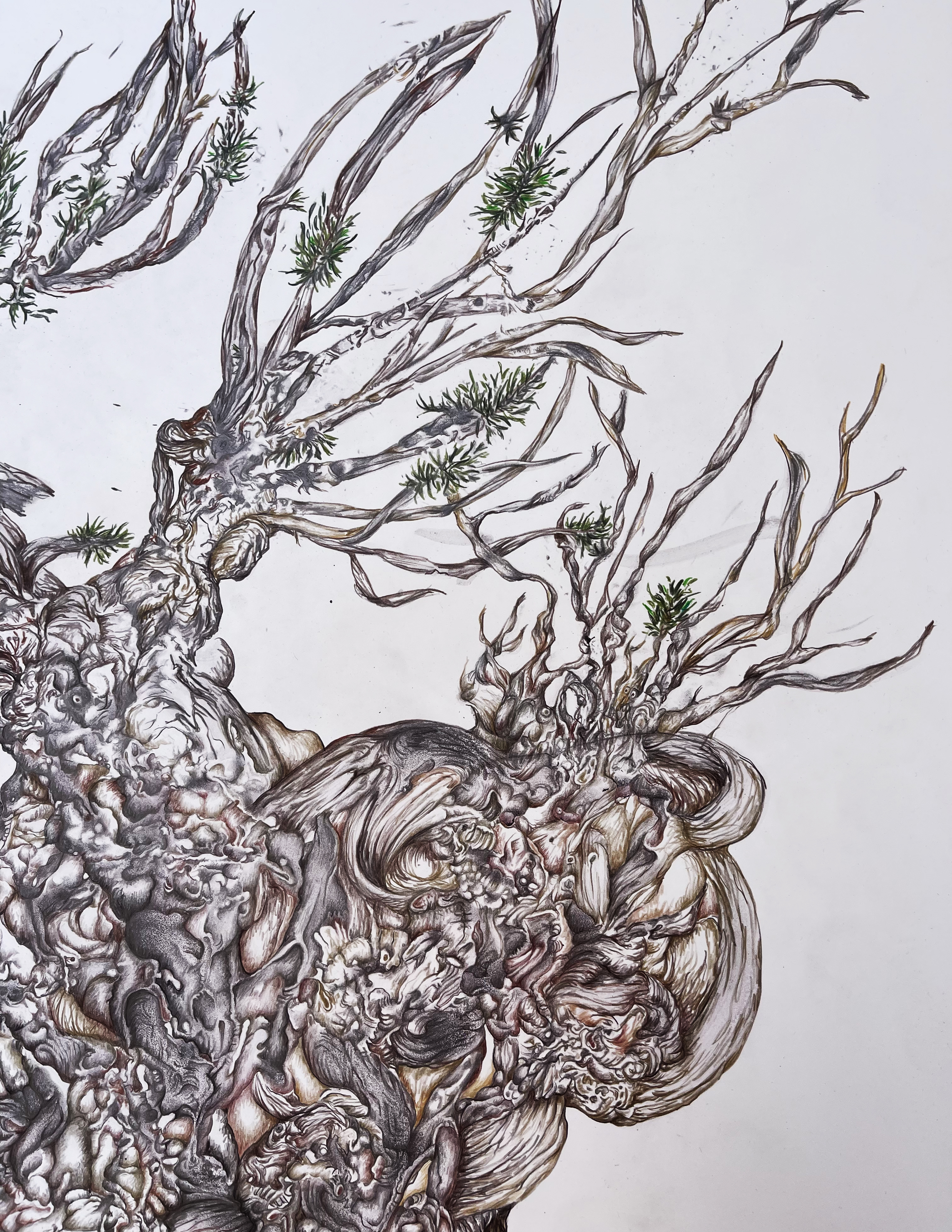
However, the saddest part were the places where over the last 10 years a bacteria brought by an insect has been decimating the olive groves, killing millions of trees, many of which were centuries old. It took several years before the problem was acknowledged and there were conspiracy theories galore about the how, why and by whom the disease was spread. It is now steadily being controlled, but the losses were devastating. There were many places where we saw ancient trees partially dead, trying to fight back, and these were what inspired this drawing. I am not trying to draw an accurate representation of an olive tree, more getting the essence of these ancient behemoths, capturing the sense of age in the twists and gnarls of the trunks, taking it to an almost abstract form.
This is a large drawing, 94 x 64 cm. The base was drawn in Liquid Pencil, the top layer in coloured pencils, a mixture of Caran d’Ache Luminance and Derwent Lightfast, on yupo paper.


 anna warren portfolio
The form you have created is simultaneously a living and a dying body. Its little clumps of leaves defy the odds … at least for the present. Perhaps I would interpret it differently if I hadn’t read your words. Now I see it as a testament to time, to life and to mortality.
I love the negative space within the trunk, kind of mirroring the upper branches.
As often with your work, it is a universe within a drawing.
LikeLike
Putting an explanation – and even a title – to an artwork immediately gives a the viewer a starting point for the way they view the artwork, which has pluses and minuses. Sometimes in a major gallery the explanation clarifies understanding of an obscure work, which can open one’s eyes, other times a bad title or explanation can diminish the artwork. I do like people to interpret my work in their own ways, so I would be fascinated to know what your initial interpretation would have been!
LikeLike
I can’t say what my initial reaction would have been because I read your piece straight away so I was already thinking about the killer bacteria when I studied the drawing. Next time I will look for a while before I read.
LikeLike
That’s the interesting thing about a description isn’t it, once read it is impossible to unsee it!
LikeLike